

And Action! An Examination of Physics in Video Games
Video game physics are something that we often accept for granted. If you make your avatar jump, you expect it to come up down and not go shooting off into space. Although, if you have played Skyrim long plenty, you know that this tin can happen anyway. However, bated from glitches, quirks, or intentional game physics that don't mimic the existent globe, we expect in-game objects to conduct in ways that make sense, then we don't retrieve about that fact that these laws must exist baked into the game.
Programming physics into a game can be as simple as one or ii routines with a few lines of lawmaking each, or as circuitous as requiring a completely dissever physics engine like Havok or PhysX with millions of lines of code. Regardless of the complexity or whether a game engine requires middleware to handle the computations, game physics falls into ii broad categories — rigid body and soft trunk.

Rigid body physics is generally defined equally forces that act on a solid object. It is required for most second and 3D games. Soft trunk physics is applying physical forces to a deformable mass — like a flag. Soft torso is much more than circuitous to simulate. For this reason, it is used far less and depending on the game, may non be required at all.
In this article, nosotros'll delve a bit deeper into these two types of physics and explore how and why they are used in video games. Nosotros will avoid the deep technical dive for now, but may investigate the complexities further in a future installment.
The Importance of Game Physics
Developers employ physics in games for a variety of reasons, but the most important factors to consider are intuitiveness and fun cistron. If an object in a game does not behave in a anticipated mode, it would be tough for the histrion to figure out how to play.
For example, if you started a FIFA twenty friction match and whenever the brawl striking the turf information technology bounced in a random management, it would be very difficult, if non impossible to figure out how to get it downwards the field and into the goal. Therefore, game makers try to simulate how the ball will bounce based on trajectory, velocity, and other existent-globe factors, so that the thespian intuitively knows how to manipulate the brawl or whatever other object. Ironically, FIFA xx has suffered a spate of bad user reviews precisely because its physics don't work as fans expected.
However, that is not to say games have to abide strictly to the natural laws of physics. In fact, most developers bend the rules for the sake of fun. The game has to exist enjoyable to play later all. If the physical forces are as well lifelike, information technology can ruin the fun factor. For example, imagine what it would be like to play Thou Theft Motorcar V with unforgiving physics — there's a mod for that by the way.
Even a slight collision with another object at high speed would upshot in a wreck ruining the player'southward getaway. Not so fun.
So there is a fine line between making a game enjoyable to play and it existence physically realistic. It is the responsibleness of the developers to strike the proper residue, which is oftentimes dependent on the demographic they are targeting. Racers are a expert case.
Many gamers savor arcade-manner racers, like Need For Speed, that don't punish them too harshly for scraping a guardrail or taking a corner also fast. A smaller demographic prefer sim-racing games that are a closer approximation to reality, such as Gran Turismo. Even when creating sims to satisfy a smaller market, game makers have to find a fashion to lure other players, or else the game will do too poorly. Gran Turismo initially relied on photorealism to attract other players, which worked to an extent. Still, Polyphony Digital eventually added an arcade mode to the serial to cater to a broader market.
Now that we know why game designers apply physics, let's accept a closer wait at the ii types, how they are used, and what developers do to keep the calculations required from exceeding processing capabilities.
Rigid Body Physics
When we remember of video game physics, we are usually considering rigid trunk physics (RBP) as this is arguably the virtually important, and something that most games must implement in 1 way or another. Rigid trunk physics deals with simulating and animating physical laws on solid masses. For case, the ball in the FIFA 20 example above is a rigid torso that is acted on past the game physics.
Whether it is a 2D game similar Pong or a 3D such equally Skyrim, nearly video games deal with linear rigid body physics.

2D Video Game Physics
Allow'south become all the way dorsum to Pong — two rigid bodies (ball and paddle) repeatedly colliding with each other. Gee, when you put it that way, information technology doesn't sound fun at all. The granddaddy of video games did not realistically model real-globe physics. For ane, its programmers ignored calculations involving gravity, friction, and inertia. It was simply a ball going dorsum and forth at a abiding speed.
Second, the bending of the brawl rebounding from the paddles was non calculated accurately. The ball's bounce completely ignored the law of reflection. This law states that disregarding other factors such as spin, a ball hitting a surface at a given angle will rebound at an equal angle.
In Pong, the reflection angle was determined by the proximity of the touch on to the heart of the paddle. Regardless of its initial trajectory, the ball's reflection was based on how far from middle it struck the paddle. So players could completely opposite the ball's momentum, regardless of its incoming vector.
Athwart trajectory would come into play more with later iterations and other paddle games like Breakout. All the same, even and so, the numbers were usually fudged. It all comes dorsum to the fun factor. Mimicking deflection too closely to reality was less fun and often more difficult to play.

Artillery games were the get-go to kickoff incorporating factors like gravity and resistance into the mechanics. For those also immature to remember, artillery games were where players would take turns firing cannonballs, arrows, or other projectiles at each other trying to destroy their opponent's base. These games used semi-realistic ballistics that took account for things like the angle of launch, gravity, wind resistance, and initial velocity. Again, designers did not make the games besides truthful-to-life. Their target audience was the average joe, not ballistics experts.
The rigid bodies in artillery games, primarily the projectiles, were acted upon by the diverse forces, and the animations adjusted accordingly. Arrows or missiles are a good example of animating a rigid body in these games. While the plane of the projectile would change during flying, the arrow itself would remain directly. It did not bend as it completed its arc, which is what nosotros would wait. This example might seem oversimplified considering of its intuitiveness, merely it is important to understand when distinguishing it from soft torso dynamics. Whatever ii points on an object in a rigid body arrangement volition always remain the same distance autonomously.
Games like Donkey Kong, and subsequently the Mario Bros games, fix the stage for how physics would touch the 3D games to come.
Our good plumber Mario complied with very general concrete laws like gravity, momentum, and inertia, even in the earliest games. Jumping was the primary game mechanic, and it has since get a staple that will never go away. When dealing with jumping and gravity, we intuitively know that what goes upwards, must come downward.
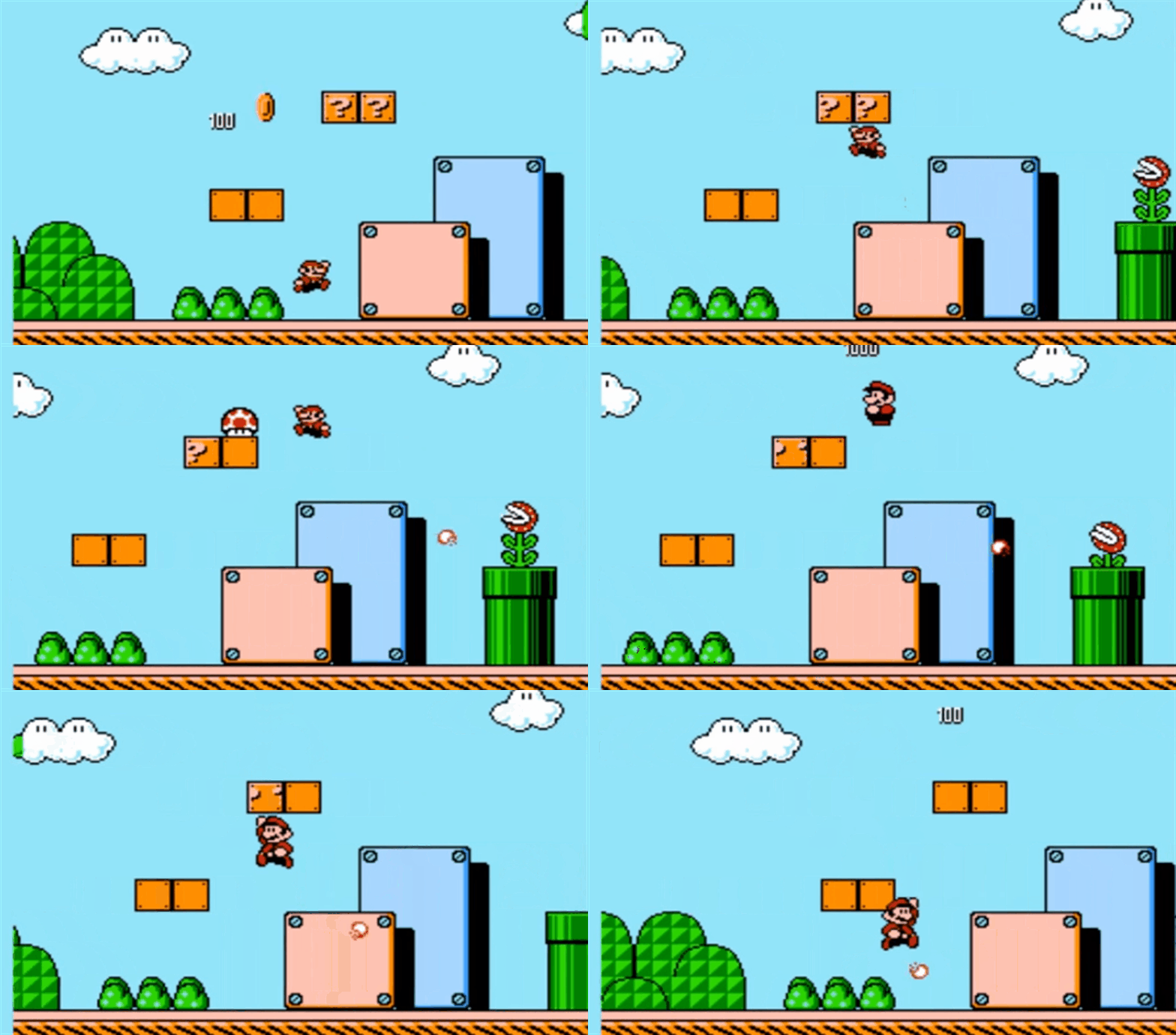
The question is, how high does it get up, and how fast does information technology come downwards? It is something developers have to consider carefully in their game blueprint; just how close to reality does the game'southward gravity have to be?
If Mario was forced to obey real-world laws, he would probably never make information technology past level one. And then, developers had to discover that balance to make the game playable while maintaining the intuitive expectations players would take about how Mario should bear in his world. Later games would stretch the bounds further by introducing the double spring. Super Mario 64 was the offset game in the series to implement the double jump, although it was used in prior games, as far back as Dragon Buster in 1984.
The double jump immune players to leap college vertical or horizontal distances to articulate gaps or reach ledges. The game mechanic became popular in platformers virtually to the point of overuse. Information technology is still a staple in many mod platforming games but is also seen in 3D games like Devil May Cry and Unreal Tournament besides, which brings us to the 3D realm.
3D Video Game Physics
The physics used in 3D games is not that much different than what developers used in their 2D cousins. As mentioned before, fifty-fifty the double leap exists in some 3D games. The main difference is the complexity of the computations when adding in a third dimension (z-centrality) and objects made up of multiple rigid bodies.
In most 2D games, developers only have to contend with detecting the collision of a few solid objects at a time. For case, Mario landing on pinnacle of a Koopa. Any part of Mario tin can touch whatever part of the Koopa. How that contact occurs determines whether the Koopa gets bopped or Mario loses a life. Either way, information technology is simply one standoff.

Most 3D titles have multiple solid objects interacting with each other. Take the Uncharted series equally an case. When Drake scales a cliffside, the programme is looking for collisions with at least his hands and feet, which are all split up rigid bodies. If he leaps and only one hand catches a ledge, the animation will be different than if both connect.
Speaking of each limb being a split rigid body, 3D games (and some 2d) accept models with multiple rigid bodies held together at joints. In other words, a homo model's arm may take a manus and a forearm continued at the wrist with that linked to an upper arm then on. This structure and how it behaves is referred to as "ragdoll physics."

Paradigm: University of California, Riverside
Ragdoll physics is used in well-nigh, if non all, games with player or NPC models. The connections of the various rigid bodies that make up the limbs are created on the game engine's skeletal animation arrangement. Each rigid body must human activity under a set of rules to wait realistic when moving.
To compute these movements, programmers use a variety of techniques. The most common is Featherstone'south algorithm, which is a constrained-rigid-torso approach that keeps the limbs from flying around like plane props, although sometimes they nevertheless do to comedic upshot.
Other types of ragdoll handling approaches include Verlet integration (Hitman: Codename 47), inverse kinematics (Halo: Combat Evolved and Half-Life), blended ragdoll (Uncharted: Drakes Fortune and many others), and procedural animation (Medal of Honor serial).

All of these techniques endeavor to solve the problem of a torso going limp too fast and crumpling to the basis with its joints going this style and that like — well, a ragdoll. The rigid bodies making upward a model are constrained in their movement then that they acquit in a predictable manner, even if the the game'due south physics are not completely based in reality.
But equally in 2D titles, game makers have to notice a balance between realism and fun. So when computing concrete forces inside the game, the calculations are often not entirely accurate; that is to say, "the game cheats."
Take the Sniper Elite series as an case. In the real world, military snipers have to make every shot count, so they consider quite a few factors when lining upwardly a target. Current of air speed, wind management, range, target movement, mirage, light source, temperature, barometric force per unit area, and the Coriolis effect are but a handful of variables that real-life crack shots have to factor into their position and aiming.
If Rebellion chose to go the route of making an authentic sniping simulation, not only would the game be very hard for most players, the number of calculations, and thus the amount of programming and processing power would increase significantly. Crunching these variables is not taxing on today's processors, merely the average player does not want calculate these factors when playing, permit alone fifty-fifty understand them. Therefore, it is much simpler (and assisting) to just allow the histrion to line up the target in the crosshairs and let them score a hit, preferably with a slo-mo bullet cam.
That is non to say that games have non attempted to make sniping more than complicated. Telephone call of Duty: Modern Warfare has a campaign level that involves taking out a target from long range. The player must debate with the Coriolis effect and wind speed/management (above). The mission is frustratingly catchy, enough so that I eventually put it downwards and played something else. That is non to say that some players do not similar that challenge. Some called it the best mission in the game. I just don't have the patience for it.
Racers are another genre where a lot of calculations are washed regarding rigid bodies and the forces applied to them. Tire meets the road, chassis connects to the wheels, cars bumping one another, and many other solid objects have to be calculated into collisions actively and passively.
Concrete forces pushing the cars during cornering are usually fudged, especially in arcade racers, making globe-trotting extremely easy when compared to existent-life but nonetheless challenging enough to give players a sense of accomplishment when they pull off a tricky maneuver.
The forces interim on cars in sim racers similar Gran Turismo or Assetto Corsa are more realistic and take into account several factors that arcade racers ignore. Assetto Corsa Competizione (version i.0.7), for example, introduced a five-point tire model into the game.
This five-betoken physics model consists of ii contact points on the forepart edge of the tire footprint, ii on the rear, and ane in the eye. Most other racers just have a single point of contact on each tire. Each of the regions acts equally a connected rigid torso. They can movement and flex in 3 dimensions, independently reacting to forces and surface contact. This sophisticated model allows for much more realistic reactions when cars, for instance, strike or edge up on a curb.
Notwithstanding, the actress contact points up the calculations done by the physics engine considerably. Fortunately, ACC'south engineers have figured out a way to do this without increasing the computational load so much equally to touch game operation negatively.
As you can probably tell, physics models in 3D games tin can be far more complicated than their 2D counterparts. Many more variables and collisions must be tracked to keep the physics on an even keel. However, most calculations are still linear and, therefore, more straightforward than soft torso physics models.
Soft Body Physics
Soft body physics (SBP) deals with deformable objects and is far more than circuitous than RBP, which is why we saved information technology for final. It'southward also less utilized and more simplified in video games than its rigid body counterpart because of the massive amount of computation information technology requires to simulate realistically. Therefore, all soft-body models in video games are brought down to a manageable level in i style or the other due to processing limitations.
Some soft trunk physics examples would be fabric, hair, and collections of particles like fume or mist. Unlike a rigid torso where whatever two points remain the same distance from i another, soft bodies tin can morph and move so that 2 points on the torso tin can move closer or further from each other.
Soft Body Solids
At that place tin exist many restrictions on the corporeality of motion in a soft body, or there tin exist none. For case, let'southward expect at a flag. All points on the flag are constrained to remaining on that flag — they can't merely go flight off into space. All the same, every bit the flag moves, the distance between whatsoever two points can vary. The range that they tin motion away or toward each other depends on the distance between them when the flag is flat.
In other words, adjacent points are constrained to remain adjacent, while distant ones can motility close plenty to get adjacent but cannot become more than distant than their flat state span. The number of configurations of all the points on the flag, while finite, is still staggering.
The calculations required to simulate a billowing flag using an SBP model accurately far exceeds the capabilities of unmarried processor CPUs and GPUs. So, developers often rely on shortcuts to mimic the random movement of a flag blowing in the wind. A manual looping animation is one straightforward method merely tin wait canned afterwards a while, then it is best used where the flag is not the center of attention.
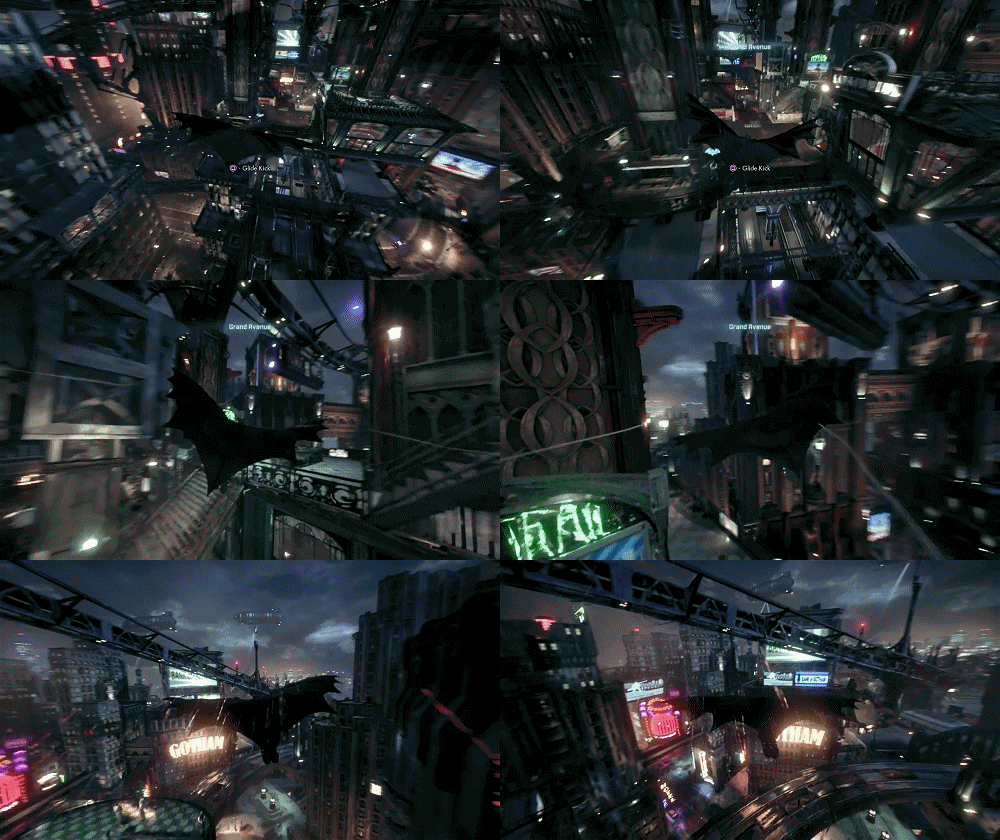
Clothing, while nearly identical to a flag in its soft body backdrop, is more challenging to use physics to, both considering information technology is a focal point for the player and because it often is more than dynamic in terms of player input. Batman's cape in the Arkham games is a perfect example.
Designers cannot use looping animations for Batman'southward cape considering its morphing relies on how the player moves. It cannot but flap around randomly similar a flag because it will not look right. If the player moves to the left, the greatcoat has to move to the right to realistically simulate the forces of inertia and air resistance acted upon information technology.
To handle these complex variables, game makers employ physics engines to handle the piece of work for them. In Batman: Arkham Knight, developer Rocksteady used Apex Fabric PhysX. This tool allows designers to create a mask for textile bodies and set parameters for how it should move. Depending on how it is configured, anything from silk to burlap can be faux.
The parameter settings likewise allow programmers to limit the natural forces on the textile for the sake of improve performance. For instance, "Wind Method" tin be ready to "Accurate" or "Legacy." Legacy ignores elevate and elevator, thus reducing the calculations that need to be done.
Additionally, non all points on a piece of cloth are factors. Instead, portions are grouped together, reducing the number of vertices that need to be accounted for from millions to tens of thousands. Fifty-fifty then, not all of these groupings collaborate with one another as they would in an bodily soft body organisation. Mainly they only collaborate with nearby points, which brings the number of mathematical computations done to a very manageable level.
Soft Body Particle Systems
Dissimilar cloth or hair, particles such equally smoke or clouds are far more complicated to simulate. Any 2 points inside a particulate object tin can movement in a nonlinear fashion. They are not constrained to the confines of the soft body, meaning ane or more points tin can move beyond what can be considered the limits of the object and tin can even grade other soft bodies.
You lot don't have to await that far back to observe games where explosions, fire, smoke, or dust looked unrealistic because transmission animations were used. Even some contemporary titles put very piffling focus on particle physics because information technology is too hard and taxing on the processor.
However, physics engines have improved particle systems to a smashing degree over the years. Just lookout man the title screen of Skyrim to run across how realistic illusions of smoke have become (below).
Generally speaking, each particle in a soft body system has a static lifespan. This period goes from the time it is spawned to the time it fades away before being respawned from the particle'southward source. During that time, the bespeak will movement according to prepare parameters.
Have smoke from a campfire, as an instance. Each particle is blithe with a trajectory that is more often than not up and away from the source (the burn). The particles do not travel straight upward in a linear fashion, merely rather swirl and randomly alter their position in 3D space. They practise this until they are removed from the simulation, based on their lifespan.
The lifespan roughly determines how realistic the particle organisation looks. A long lifespan tends to create very realistic campfire smoke but is taxing on the processors. A curt lifespan is more than forgiving computationally but results in particles that simply go up a lilliputian way from the fire before disappearing.
Going dorsum to the Skyrim championship screen example, the smoke consequence here looks very realistic considering there is nothing else happening on the screen other than carte du jour selection, which takes minimal CPU cycles. And then the full power of the CPU and GPU can exist devoted to simulating smoke particles with very long lifespans. As you watch y'all can see the particles evaporate before they are respawned again.

Switching to actual gameplay, you will notice that smoke around fires is non as realistic looking. It is still pretty disarming, but watching it for a while volition reveal that it relies on shortcuts to replicate a particle arrangement. Developers can practise this in a number of ways, including shortening the amount of time a particle remains in the simulation, but they may use other tricks besides. Interlacing a number of static smoke layers is a common method.
In curt, soft body physics in all games is limited. For one, information technology is non necessary to fully simulate SBP since it is usually simply at that place for aesthetics. Secondly, accurately replicating a soft body system requires also much horsepower making it impractical to implement on gaming systems. Full SBP simulations are all-time left in the physics labs.
What Accept Nosotros Learned
Video game physics is a circuitous field where developers must find a balance between realism and the compromises set by computational limitations. Finding shortcuts and relying on physics engines allows programmers to mimic real-world physics quickly and efficiently so that they can focus on more critical aspects of the game like the mechanics.

The bottom line is to arrive fun. Realism takes a backseat to engaging gameplay. This is non to say that game physics is optional. On the reverse, designers must employ it in one form or another, or else the game will be cluttered with no intuitive rules. They can as well bend the natural laws to make gameplay more fun and rewarding, such as including the ability to double jump.
If you are interested in the more technical points of video game physics and the fashion that game makers employ physics engines, there are several resource to get your started. Check out the physics department in the Unity transmission or the Lumberyard tutorials. We may also cover the topic in more depth in a time to come commodity.
In the meantime, information technology may exist fun to retrieve about the things we have discussed as you lot play your next video game. Just like we explained how 3D rendering works in video games, can you spot shortcuts developers have used or find innovative means that they employed physics in a manner that enhances gameplay? Give it a become and permit usa know.
Proceed Reading. Explainers at TechSpot
- L1 vs. L2 vs. L3 Cache
- What Are Tensor Cores?
- Navi vs. Turing: An Architecture Comparison
- Explainer: What Is Chip Binning?
- How 3D Game Rendering Works: Lighting and Shadows

Source: https://www.techspot.com/article/1960-video-game-physics/
Posted by: haughtopas1988.blogspot.com
0 Response to "And Action! An Examination of Physics in Video Games"
Post a Comment